
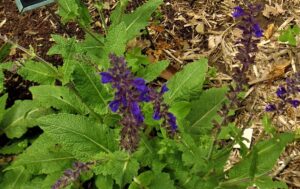
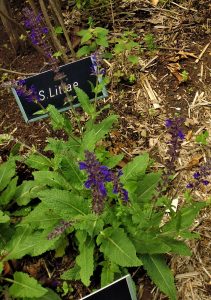
Salvia superba ‘Viola Klosse’: is a small herbaceous perennial which forms a clump of rosette leaves and vibrant dark purple spires of flowers 20-30cmH in spring for a full sun position.

Salvia superba ‘Viola Klosse’ is winter dormant, coming up again in Spring.
Flowers: are a violet purple falcate type with a straight or curved hood and the bottom lobes all the same colour. The 2 side lobes jut out a bit leaving the middle lobe slightly cupped to hold a drop of dew and to act as a landing place for a bee or pollinating insect. Often after the flower has been visited the bottom lobe begins to fall downwards, indicating that a pollinating insect has already visited the flower.
There is a slight change of colour around the throat area to indicating a beeline to allure bees to explore further into the flower.
Flowers are held in whorls of 6 flowers, having 3 on either side of a green square stem, which colours as the flowers ascend to the tip of the flower head. The lower flowers open and gradually continue to open until all is opened at the tip.
Multiple spires of flowers appear in mid spring, after the clump of rosette leaves have been formed, being well above the foliage to attract passing insects. Flowers continue well into the summer, with most blooms having finished by February/ March.
Calyces: are a crimson/ purple colour, well ribbed and slightly hairy. When still in bud the whole flower head is quite hairy with soft hairs all around the calyces, but seem to drop off when the flower opens. If the flowers are not pollinated, they will still remain, but if pollinated they will grow fat with seed and gradually turn a straw colour, the others may drop off.
Stems: are square and green, colouring up towards the tip of the flower head. One central spike appears which branches into more flower heads.
Leaves: are small, a bright green, broad lanceolate shape with a pointed tip and a prominent mid vein. Most leaves are slightly lobed with small crenulations around the edges.
Small sessile leaves are seen beneath the branching of the stem,with small green hairy bracts being found beneath each flower whorl.
Larger leaves are found at the base of the clump with small leaves are found towards the centre.These will continue to grow when the flowers have finished.
|
|
|
|

‘Viola Klosse’ is a great edging plant, being small, neat and tidy, perfect to edge a path.
If growing in groups of 3 or 5, they make quite a show when in flower, by themselves or in a mixed border with other small shrubs and perennials in pinks, crimsons, white or yellows. Grown in full sun they make a good display in the foreground of a simple hedge.
Not fussy with soil, but it should be well drained and kept moist in summer with mulch. These are quite tough and hardy when well established.
Maintenance: before the plant appears in spring, feed the crown well to bring on those first few leaves to get them growing quickly. Keep a look out for snails and slugs. Spray slug and snail “Eco snail” on the leaves to deter those small tiny snails. This spray will also help to deter rabbits, deer and Wallabies and any other foraging animals. Being able to get the leaves up quickly, allowing them to mature before sending up the flower spikes also allows the Sulphur smell to develop within the leaves, thus deterring rabbits and other animals.
Continue to the mulch, to keep the roots cool in the hot dry summer months.Mulching also helps to show off the lovely leafy clump.
When Winter begins and the plant begins to go down during the colder months, clean away old leaves, feed ( this is for the nourishment of the roots) , and mulch to keep the roots warm during the cold winter months, mark with a coloured stake, so the clump is not accidentally trodden upon or accidentally dug up.
Propagation: usually by seed, sown fresh in late summer or autumn. Cuttings of 2-3 nodes or slips can be taken when the clump is well formed. These can be treated like normal cuttings. If the clump is large, then digging up, separating or cutting the clump up is also possible, making sure that each division has plenty of roots, but if not, then the stems should be treated as a cutting. Check the propagating page for more information on how to take cuttings.
Not readily available