
Salvia superba ‘Rose Queen’: is the same or very similar to the many varietal hybrids found. All produce a rosette clump of leaves, small stems and many stems of pale pink flowers in spring.
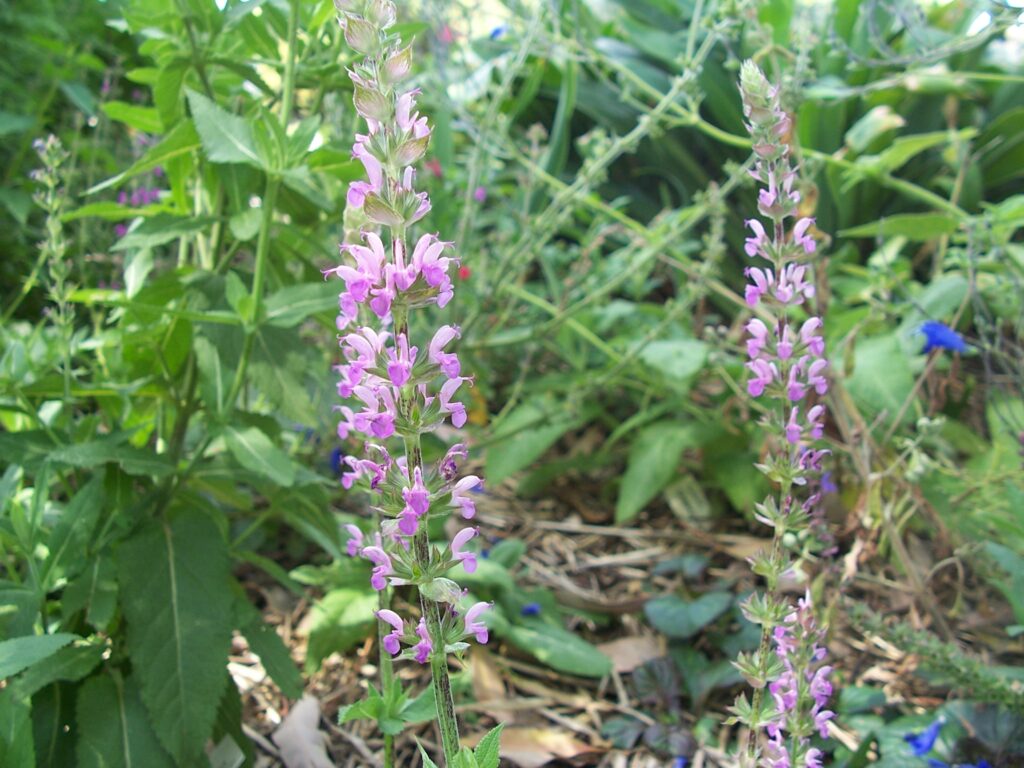
Flowers: are a falcate type, small and pale pink. The hood is straight, thick and a pale pink with the pink stigma protruding from the tip and curling. The bottom lobes are a brighter pink, with the 2 side lobes being tucked in and the middle lobe forming a cup. This is to hold a drop of moisture and act as a landing place for bees and other pollinating insects.
The space between the hood and lobes is quite open allowing plenty of room for insects to land and venture into the flower. Once the flower has been visited the bottom lobe seems to hang down indicating that this flower has already been visited.
Flowers are held in terminal spires in whorls of 6 flowers, 3 flowers on either side of a green square stem. There are often buds at the tip of the spire that don’t open until the bottom flowers finish, which prolongs the flowering period. Most flower heads are 10-15-20cmL.
Each clump produces numerous flower stems, as these may be branched, many dense flower heads can be produced per plant.
Flowers are held well above the foliage to attract any passing bees and insects.
Flowering time: Flowers appear a little later than the Nemorosa types, but the flower stems come up quickly once the clump has been formed, usually early to mid spring in October/ November. Most will be in flower over the Christmas period, but usually ending by February. Some newer varieties may have longer flowering periods.
Calyces: these are usually small and green, although some more recent varieties may have coloured ribs. All have pointed lobes. They tend to stay on after the flowers have finished, hopefully full of seed.
Bracts are small, triangular and green, with some being coloured. These are found beneath each whorl of flowers and at the base of the flower stems where they branch.
Leaves: are small, mid green, lanceolate in shape with a pointed tip, finely rugose texture with the midrib easily seen and small rounded crenulations around the edges.
Salvia superba ‘Rose Queen’ is wonderful as a border plant along the edges of paths or in low mixed borders. Wonderful at the front of a mixed meadow setting.
Grow in full sun with other small perennials . This contrasts well with whites, mauves and purple and stronger pink perennials and small shrubs. An excellent plant in gravel gardens or planted en masse as a ground cover with a taller hedge behind.
Not fussy about the soil, so long as it drains well. Once established, they are quite hardy in the summer season until they go down for the winter. They do appreciate extra water when the weather is hot and dry.
Maintenance: Before the leaves appear in early spring, give the crown a feed with blood and bone or other fertiliser, making sure you water well so it doesn’t burn the new leaves, to give the new growth a good start.
When the leaves first appear in spring, snails, slugs and rabbits love to forage on the leaves. It is best to cover the plants with chicken wire to stop foraging animals but also spray with a snail spray which doesn’t smell or taste very nice. It works on white butterflies as well sa the tiny snails that make holes in leaves.
When the plant is growing well mulch well to keep the roots cool over the summer season. Water well when looking dry. When the plants have finished and beginning to go down for winter, remove any seed stems and cut back any old stems. mulch well again to keep the crown warm during the cold winter months and mark well with a coloured marker. This prevents the plants from being dug up or trodden upon.
Propagation: Usually by seed, sown in spring/ summer, kept in pots until big enough to plant out. Most clumps can be divided or small new shoots can be taken as cuttings. Visit the propagation page for more tips.