
Salvia superba ‘Snowhills’/ ‘Schneehugel’/ ‘White Sensation’: These are all similar small herbaceous plants 40cmH, with a basal clump of leaves, and spires of white flowers in spring and summer, for a sunny position.
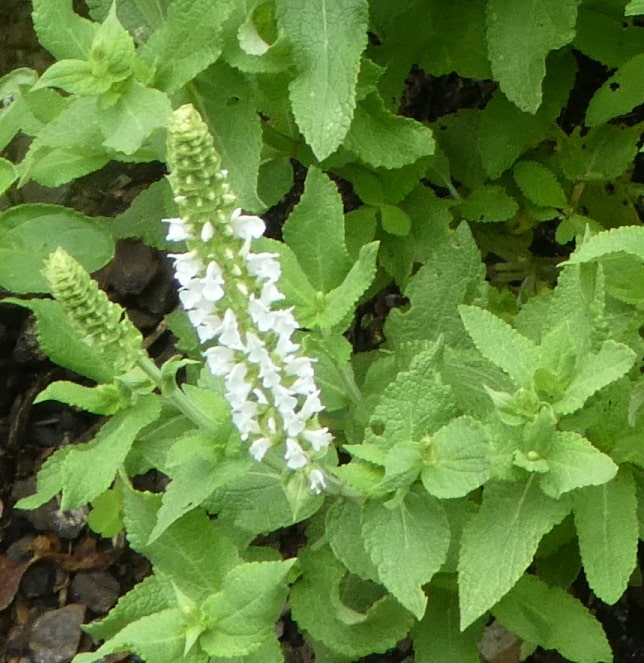
Salvia superba ‘Snowhills’/ ‘Schneehugel’/ ‘White Sensation’: are virtually the same plants, with
different names given to the some newer varieties.
Flowers: are small and white, a falcate type of flower. The hood is straight and smaller than than the bottom lobes. The 2 side lobes often stick out to the side leaving the middle lobe cupped. This is to hold a drop of moisture, act as a landing place for bees and pollinating insects. When the flower has been visited, the middle lobe hangs down, indicating to the insect not to bother visiting.
Being a falcate style, there is a large gap between the hood and the bottom lobes, this space is large enough to allow the bees to enter the flower and explore further.
Each flower is in a whorl around a square green stem made up of 6 flowers, with 3 being on each side. These whorls are all tightly packed along each stem. Some spires can reach15cm L, but usually 10-12cmL. Opening at the base while the buds are waiting to open at the top. This prolongs the flowering period. All flowers are set well above the foliage to attract any passing insects.
Flowering begins in mid to late spring, around October/ November, a little later than the Nemorosa types as the superba types need to form their basal rosette before sending up their short flower stems, either single or branched. Once they begin to flower, they will continue through out the summer, continuing into autumn if they haven’t been cut down early for another flush of flowers.
The white of the flower looks so pure because the calyx is green, which sets off the white beautifully, acting as a wonderful contrast in colour.
Calyces: These are small and green. Each lobe is ribbed and pointed. They will remain on the stem after the flower has finished, hopefully containing seed.
Bracts: These are small, green and triangular shaped. They appear under each whorl and under a branching flower stem. They will eventually fall off, usually when the flower has finished.
Leaves: Are small, lanceolate in shape, midgreen, a pointed apex and fine crenulations around the edge. They will form a basal rosette of leaves when they emerge in spring, when complete, they will then send up many branched flower stems, usually 10cm – 30cm. Any stem leaves are few and small.
|
|
|
|
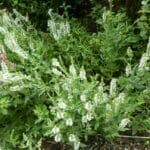
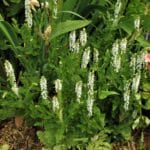
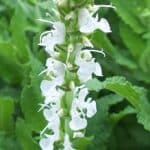
Salvia superba ‘Snowhills’/ Schneehugel’/ ‘White Sensation‘ are great border plants, being small, they don’t get tall enough to flop or become untidy. They make great plants for mixed baskets or tubs and for mixed borders, being planted in groups of 3-5 plants making a stunning splash of white. Being small they are ideal for a gravel garden or a colour themed bed. Being white, they also do well acting as a foil with darker colours, such as dark blue, a royal purple or a cerise or crimson pink and bright reds. But the same can be said with a pastel palette of pale blues, mauves and pale pinks, all do well when white is added.
Grow in a sunny position, to keep the plant compact.If grown under a tree or given toooo much shade, then the stems become floppy and don’t produce as many flower stems or large flower heads. Not fussy with soil, but should be well drained and given extra water in the heat of the season.
Although small, they are quite tough and hardy during the summer season.Given mulch around their bases will help them through the hot dry season. Because they are herbaceous( going down for winter), they are frost hardy. In some areas, that are warmer in the winter month, the crown of rosettes may remain, these cope with the cold and frost quite well.
Maintenance: is usually tidying up at the end of autumn, when they begin to go down. Remove any dead leaves and mulch the crown well to keep the roots warm in the cold season and cool in the summer months. Place a stick or marker beside the crown to stop the crown being walked on or accidentally dug up.In late winter to give the crown a feed before the leaves begin to emerge and top up mulch.
Propagation: Usually by seed, sown in summer or division if the clump is large enough to divide. Slips or cuttings can be taken from the base of new growth, taking 2-3 nodes per slip. See the propagation page for more tips on propagation.