Salvia taraxicifolia

Salvia taraxicifolia  is a small compact mound forming groundcover with pale pink flowers in Spring.

Salvia taraxicifolia

Salvia taraxicifolia  refers to it’s spiny calyces and leaves.

Flowers:
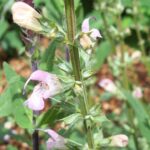
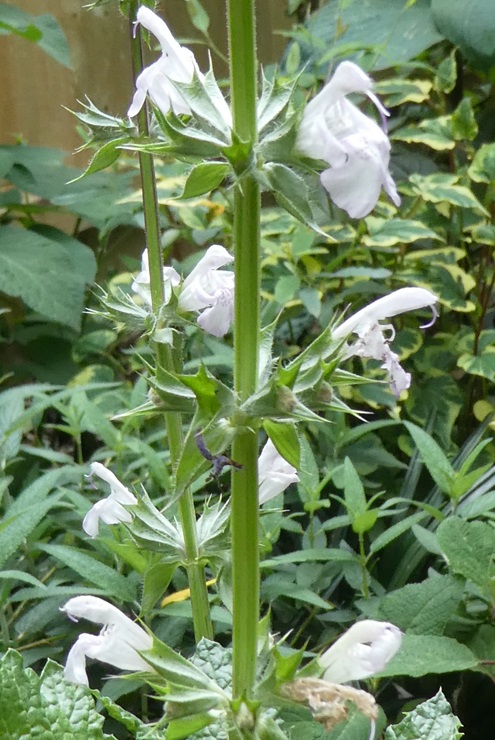
These are the palest pink, colour, often looking very white. These appear in whorls of 4 flowers around a very green square stem. Flowers are large in size, a falcate shape to allow bees and other pollinators to enter the flower. Often there are some blue/ purple markings  around the throat area, acting as a  beeline to guide the bees  and other pollinating insects further into the flower.
Flowering begins in late winter or early spring to catch the early emerging insects. All flower stems are held well above the basal foliage to attract any passing insects.

Calyces: are a dull pale green, very well ribbed with spiny tips to each lobe. A triangular bract can be seen under the whorl of flowers, which remains until the flower is finished. Most calyces remain, but eventually drop off with age. Turning brown showing that there is likely to be with small dark seeds within.

Leaves: form a basal clump, leaves are lobed, and lanceolate in shape. These are pale green with a blue hue, very well veined, even fissured, with a spiny tip at the end of each lobe.
Salvia taraxicifolia

Salvia taraxicifolia

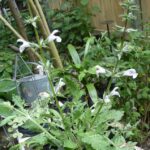
Plant in the front of a bed in a row  or in a group of 3 at the intersection of pathways, forming the perfect low clump that doesn’t get stepped upon . It loves the sun, so does well in a gravel garden in well drained loamy soil . Plant with either a strong coloured small shrub behind or plant with other pastel coloured low shrubs and perennials. As the leaves have a blue/ green tinge, it goes well with silver/ grey plants or acts well as a contrast with strong coloured small shrubs.
Grow in full sun, it prefers a good drained position with decent soil, mixed with grit and a bit of sharp sand’s, proving  very hardy for both the summer and winter seasons, once established, it tolerates light frost.
Maintenance:  As it flowers mainly in Spring, and after the flowers have finished and seed collected, then cut down the stems, clean out old leaves and fertilise.
Feed well and mulch to keep the roots cool in the hot dry summer season and warm in the cold months.
In late winter, early spring, feed well to encourage flower stems and mulch to keep the roots cool in the summer season.

Propagation:  usually by seed, but the clump has grown, then small offshoots can be taken as either cuttings or as a rooted piece to grown on.